
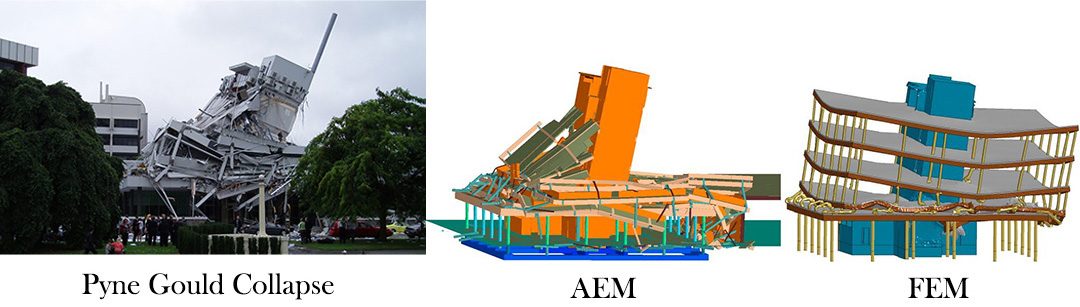
Reliability of collapse simulation – Comparing finite and applied element method at different levels
Numerical prediction of progressive collapse of buildings due to extreme loading is still a challenging task. However, increased computational power makes it nowadays possible to analyze not only small-scale connections and mid-size building elements, but also full buildings with considerable height and complexity. The present paper compares the results of Finite Element Method (FEM) and Applied Element Method (AEM) simulations to experimental results when performing blast or earthquake analysis on those three scales. The aim is to highlight which level of physical detail and complexity is required to predict progressive collapse numerically, and which level of accuracy can be expected. For the full scale level, the progressive collapse of the Pyne Gould Corporation Building in Christchurch, New Zealand, was simulated and compared to the final collapse shape. It is shown that the FEM is able to predict the structural response of small scale models well, but fails to achieve realistic collapsed shapes in case of the large structure, whereas the AEM shows convincing results in all cases.